Jio AI Chat
Pattern
Redesigning the AI-powered customer support chatbot for Jio — improving satisfaction, cutting call volume, and scaling to 400M+ users.
Year
2025
Type
Consumer App / Conversational UI
Timeframe
12 weeks


My Role & Team
My Role
Lead Product Designer
Team
1 PM
2 AI Engineers
4 Developers
Customer Support Leads
Data & Analytics
Responsibilities:
Led end-to-end UX strategy for conversational AI.
Conducted discovery, heuristic evaluation, and user interviews.
Defined reusable conversation patterns and interaction principles.
Designed scalable chatbot components for adoption across Jio products.
Worked closely with Product, AI Engineering, and Customer Support to balance business goals, technical feasibility, and user needs.
Problem & Context
A fragmented AI that nobody trusted. JioChat had an AI assistant — but it existed in silos. Three different chat UX patterns across retail, EdTech and customer support. Agents giving conflicting answers. No memory, no continuity, no design system. When we measured CSAT it was 2.6. Users were switching off the AI entirely and calling human support instead.
Jio serves 400M+ users across India. Its AI chatbot was the first line of customer support — but it was failing. Users found it robotic, hard to navigate, and unable to resolve real issues, leading them to call human support instead. This was expensive for Jio and frustrating for users.
/01
Problem Discovery
Four recurring pain points surfaced across every persona and product context. These became the non-negotiables — every design decision had to directly address at least one.
Inconsistent across products: The AI looked and behaved differently in MyJio, JioLearn and JioChat. Users couldn't build familiarity — every surface felt like a different product.
Dead ends with no exits: When the AI couldn't understand a query, it returned an error with no alternative path. Users were left stranded — no suggestion, no escalation, no FAQ.
Inconsistent across products: The AI looked and behaved differently in MyJio, JioLearn and JioChat. Users couldn't build familiarity — every surface felt like a different product.
Dead ends with no exits: When the AI couldn't understand a query, it returned an error with no alternative path. Users were left stranded — no suggestion, no escalation, no FAQ.
No memory between sessions: Every conversation started from scratch. Users had to re-explain their problem each time, even if they'd raised the same issue a day before.
Escalation without context: When transferred to a human agent, the full conversation history was dropped. Agents started completely blind — users had to repeat everything again.
/02

Understanding Why Users Lost Trust
Before touching the UI, I spent 3 weeks in discovery — understanding users, the business, and where the existing system broke down.
Methods:
Heuristic evaluation — Nielsen's 10 heuristics applied to existing chatbot
User interviews (n=12) — Jio users across age groups and geographies
Support ticket analysis — top query categories driving call volume
Competitive benchmarking — Airtel Thanks, Vi, GPT-based support bots globally
Analytics review — session length, drop-off points, resolution rate by flow
Heuristic evaluation — Nielsen's 10 heuristics applied to existing chatbot
User interviews (n=12) — Jio users across age groups and geographies
Support ticket analysis — top query categories driving call volume
Competitive benchmarking — Airtel Thanks, Vi, GPT-based support bots globally
Analytics review — session length, drop-off points, resolution rate by flow
/03


What We Learned
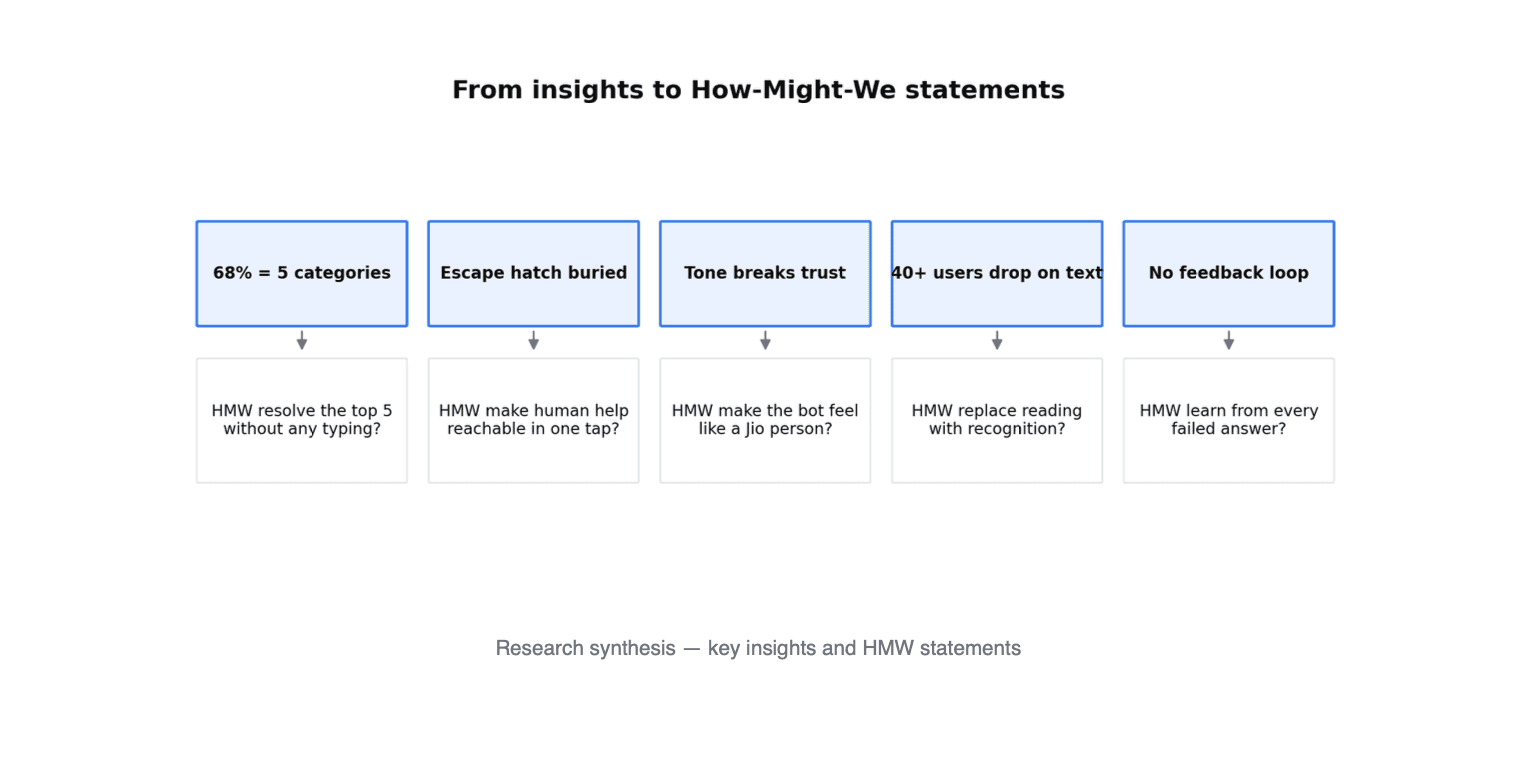
5 insights shaped every design decision that followed.
68% of queries fall into just 5 categories
Recharge, plan details, network issues, bill payment, SIM activation. Solving these well would cover most users without needing to redesign everything.
The escape hatch is the most critical element
"Talk to agent" was the most searched action in sessions — yet buried deepest. Users who couldn't find it abandoned entirely rather than continuing.
Tone matters as much as accuracy
Users over 40 abandoned even when the bot gave the right answer — because robotic phrasing made them distrust it. Feeling heard > being correct.
Older users need visual shortcuts, not more text
Users 45+ had significantly higher drop-off on text-heavy flows. Card-based quick replies performed 3x better in moderated testing.
No feedback = no improvement loop
Without thumbs up/down data, Jio had no way to identify failing responses. A feedback mechanism was both a UX feature and a data infrastructure need.
/04
Design Constraints & Success Criteria
Constraints:
This project wasn't just about designing a better chatbot. We had to balance AI capability, business goals, and the realities of supporting millions of users across multiple Jio products.
AI responses varied in reliability across different intents.
Existing chatbot implementations differed between products, making consistency difficult.
Customer support required seamless handoff without increasing agent workload.
The solution needed to fit within the existing Jio Design System while remaining flexible enough for future AI capabilities.
Delivery timeline prioritized high-impact improvements over a complete rebuild.
Principles set for this project:
Before exploring solutions, we aligned on measurable outcomes.
Success would be defined by:
Higher customer satisfaction (CSAT)
Reduced customer support calls
Faster issue resolution
Higher self-service completion
Reusable conversation patterns across Jio products
/05
Principles That Guided Every Decision
The core strategic shift: move from a decision-tree navigator to an intent-aware assistant. The bot should feel like a knowledgeable Jio representative — not a branching FAQ.
Principles set for this project:
Progressive disclosure — show only what's needed, when it's needed
Escape hatch always visible — "Talk to agent" accessible at every step, not buried
Human tone first — warm, plain language; no jargon or robotic phrasing
Resolution over engagement — success = task completed, not time in session
Accessibility by default — large tap targets, high contrast, voice input support
Feedback as infrastructure — every AI response gets a thumbs up/down
/06

Ideation & Exploration
Explored three conversation paradigms in low-fidelity before converging. Each was tested with 4 users in quick moderated sessions.
Key Concepts:
Quick reply chips handled 68% of queries without typing — critical for older users
Open text input supported complex / edge-case queries chip UI can't anticipate
Persistent agent CTA addressed the #1 pain point from research immediately
Hybrid approach allowed gradual AI capability increase without rebuilding the UI
/07
Key Decisions & Trade-offs

Decision 1
Hybrid conversation instead of AI-only
We considered a fully conversational experience but found that users preferred quick actions for common support tasks. Rather than forcing natural language for every interaction, we combined quick replies with open text input.
Trade-off
Slightly less conversational.
Much faster task completion.
Decision 2
Persistent "Talk to Agent"
Research showed users often wanted reassurance that human help was always available. Instead of hiding escalation inside menus, we exposed it throughout the journey.
Trade-off
Slight increase in agent visibility.
Large increase in user confidence.
Decision 3
Memory over personalization
Rather than introducing highly personalized AI responses, we prioritized conversation continuity. Users cared more about not repeating themselves than receiving personalized recommendations.
Decision 4
Design system before visual polish
Instead of creating unique interfaces for each Jio app, we invested in reusable conversation components that could scale consistently across products.
/08
Bringing the Experience
to Life
We started by exploring their story — a deep appreciation for nature, craft, and seasonal rhythm. From there, we developed a calm, minimalist visual identity with soft tones, refined typography, and a hand-drawn logomark.
The experience focused on clarity and ease of use, from product browsing to checkout. We prototyped key flows, tested with real customers, and refined every detail before launch. Built with performance and flexibility in mind, the final site is fully responsive and CMS-powered for easy updates.
/09


Discovery through dialogue
The assistant narrows choices by asking what a browsing filter never could — "What does she like? What's your budget?" Product cards with prices, ratings, and deals arrive inline, refined turn by turn until the right option surfaces.


Address
Selection
When the flow needs precision, it switches to structure — saved addresses, nearby locations, and building-type selection appear as familiar patterns embedded in the conversation, with delivery preferences (deliver now / schedule) built in.

Shopping
Cart
The cart summarizes selections with variants, pricing, and offers — plus smart swap suggestions — keeping full purchase control inside the conversational journey.

Partner Product Switching
One intent, every partner
The "Switch" sheet surfaces alternatives for the same product across Jio's commerce partners — JioMart, Tira, and more — with live pricing, discounts, and quick-delivery tags side by side. Users compare and swap without leaving the flow, and the ecosystem competes for the order, not the user's attention.
Leadership Beyond Design
The project's success depended on more than interface design.
I worked closely with Product Managers, AI Engineers, and Customer Support teams to align user needs with technical feasibility and operational constraints.
Some of the outcomes extended beyond the chatbot itself:
Established reusable conversational patterns adopted across multiple Jio products.
Introduced feedback collection to improve future AI model training.
Helped define scalable chatbot components within the Jio Design System.
Enabled support teams with richer conversation context during agent handoff.
/10
Outcomes & Impact
Shipped across MyJio, JioTV, JioCinema. Measured 3 months post-launch.
CSAT (from 2.6)
4.2/5
Call volume drop
55–60%
Avg resolution time
<90s
Users reached
400M+
Unified experience shipped across 5 Jio apps from a single design system
Support team reported significant drop in repeat contacts for the same issue
Feedback loop adopted into quarterly model retraining cycle
Design system components reused across 3 other Jio product teams post-launch
Dark mode shipped in v1 — highest rated feature in post-launch user feedback
/11
Reflections
What worked:
Starting with the top 5 query categories kept scope focused and outcomes measurable
Persistent agent CTA was the single highest-impact decision — simple fix, massive result
Involving support team leads early surfaced operational constraints we'd have missed in research
Treating feedback as infrastructure, not just UX, created lasting product value
What I'd do differently:
Push harder for voice input in v1 — deferred due to timeline but had high user demand, especially 45+
Run a longer regional language beta — edge cases in Hindi and regional scripts caught very late
Build a shared analytics dashboard earlier — took 6 weeks post-launch to get visibility on data
Involve the model/AI team from day one — some UI patterns had to change due to AI limitations discovered late
/12
Biggest Learning:
The biggest lesson wasn't about conversational UI—it was about trust.
Users don't judge an AI assistant only by the accuracy of its answers. They judge it by how confidently it guides them, how easily they can recover when it fails, and whether they feel in control throughout the experience.
Designing for trust ultimately had a greater impact than designing for intelligence.
Email:
hello@sagarkumar.site
Phone:
+91 70668 72321
I work with brands to define who they are, design how they show up, and create experiences that matter. Less noise, more intention.
Privacy Policy
Terms of Service



JIO AI CHAT PATTERN
Redesigning the AI-powered customer support chatbot for Jio — improving satisfaction, cutting call volume, and scaling to 400M+ users.
Year
2025
Type
Consumer App / Conversational UI
Timeframe
12 weeks
My Role & Team
My Role
Lead Product Designer
Team
1 PM
2 AI Engineers
4 Developers
Customer Support Leads
Data & Analytics
Responsibilities:
Led end-to-end UX strategy for conversational AI.
Conducted discovery, heuristic evaluation, and user interviews.
Defined reusable conversation patterns and interaction principles.
Designed scalable chatbot components for adoption across Jio products.
Worked closely with Product, AI Engineering, and Customer Support to balance business goals, technical feasibility, and user needs.
Problem & Context
A fragmented AI that nobody trusted. JioChat had an AI assistant — but it existed in silos. Three different chat UX patterns across retail, EdTech and customer support. Agents giving conflicting answers. No memory, no continuity, no design system. When we measured CSAT it was 2.6. Users were switching off the AI entirely and calling human support instead.
Jio serves 400M+ users across India. Its AI chatbot was the first line of customer support — but it was failing. Users found it robotic, hard to navigate, and unable to resolve real issues, leading them to call human support instead. This was expensive for Jio and frustrating for users.
/01
Problem Discovery
Four recurring pain points surfaced across every persona and product context. These became the non-negotiables — every design decision had to directly address at least one.
/02
Inconsistent across products: The AI looked and behaved differently in MyJio, JioLearn and JioChat. Users couldn't build familiarity — every surface felt like a different product.
Dead ends with no exits: When the AI couldn't understand a query, it returned an error with no alternative path. Users were left stranded — no suggestion, no escalation, no FAQ.
No memory between sessions: Every conversation started from scratch. Users had to re-explain their problem each time, even if they'd raised the same issue a day before.
Escalation without context: When transferred to a human agent, the full conversation history was dropped. Agents started completely blind — users had to repeat everything again.
What We Learned
/04
5 insights shaped every design decision that followed.
68% of queries fall into just 5 categories
Recharge, plan details, network issues, bill payment, SIM activation. Solving these well would cover most users without needing to redesign everything.
The escape hatch is the most critical element
"Talk to agent" was the most searched action in sessions — yet buried deepest. Users who couldn't find it abandoned entirely rather than continuing.
Tone matters as much as accuracy
Users over 40 abandoned even when the bot gave the right answer — because robotic phrasing made them distrust it. Feeling heard > being correct.
Older users need visual shortcuts, not more text
Users 45+ had significantly higher drop-off on text-heavy flows. Card-based quick replies performed 3x better in moderated testing.
No feedback = no improvement loop
Without thumbs up/down data, Jio had no way to identify failing responses. A feedback mechanism was both a UX feature and a data infrastructure need.
Understanding Why Users Lost Trust
Before touching the UI, I spent 3 weeks in discovery — understanding users, the business, and where the existing system broke down.
/03
Methods:
Heuristic evaluation — Nielsen's 10 heuristics applied to existing chatbot
User interviews (n=12) — Jio users across age groups and geographies
Support ticket analysis — top query categories driving call volume
Competitive benchmarking — Airtel Thanks, Vi, GPT-based support bots globally
Analytics review — session length, drop-off points, resolution rate by flow
View Atrifacts
Design Constraints & Success Criteria
/05
Constraints:
This project wasn't just about designing a better chatbot. We had to balance AI capability, business goals, and the realities of supporting millions of users across multiple Jio products.
AI responses varied in reliability across different intents.
Existing chatbot implementations differed between products, making consistency difficult.
Customer support required seamless handoff without increasing agent workload.
The solution needed to fit within the existing Jio Design System while remaining flexible enough for future AI capabilities.
Delivery timeline prioritized high-impact improvements over a complete rebuild.
Principles set for this project:
Before exploring solutions, we aligned on measurable outcomes.
Success would be defined by:
Higher customer satisfaction (CSAT)
Reduced customer support calls
Faster issue resolution
Higher self-service completion
Reusable conversation patterns across Jio products
Principles That Guided Every Decision
/06
5 insights shaped every design decision that followed.
The core strategic shift: move from a decision-tree navigator to an intent-aware assistant. The bot should feel like a knowledgeable Jio representative — not a branching FAQ.
Principles set for this project:
Progressive disclosure — show only what's needed, when it's needed
Escape hatch always visible — "Talk to agent" accessible at every step, not buried
Human tone first — warm, plain language; no jargon or robotic phrasing
Resolution over engagement — success = task completed, not time in session
Accessibility by default — large tap targets, high contrast, voice input support
Feedback as infrastructure — every AI response gets a thumbs up/down
Leadership Beyond Design
/10
The project's success depended on more than interface design.
I worked closely with Product Managers, AI Engineers, and Customer Support teams to align user needs with technical feasibility and operational constraints.
Some of the outcomes extended beyond the chatbot itself:
Established reusable conversational patterns adopted across multiple Jio products.
Introduced feedback collection to improve future AI model training.
Helped define scalable chatbot components within the Jio Design System.
Enabled support teams with richer conversation context during agent handoff.
Ideation & Exploration
/07
Explored three conversation paradigms in low-fidelity before converging. Each was tested with 4 users in quick moderated sessions.
Key Concepts:
Quick reply chips handled 68% of queries without typing — critical for older users
Open text input supported complex / edge-case queries chip UI can't anticipate
Persistent agent CTA addressed the #1 pain point from research immediately
Hybrid approach allowed gradual AI capability increase without rebuilding the UI
Key Decisions & Trade-offs
/08
Decision 1
Hybrid conversation instead of AI-only
We considered a fully conversational experience but found that users preferred quick actions for common support tasks. Rather than forcing natural language for every interaction, we combined quick replies with open text input.
Trade-off
Slightly less conversational.
Much faster task completion.
Decision 2
Persistent "Talk to Agent"
Research showed users often wanted reassurance that human help was always available. Instead of hiding escalation inside menus, we exposed it throughout the journey.
Trade-off
Slight increase in agent visibility.
Large increase in user confidence.
Decision 3
Memory over personalization
Rather than introducing highly personalized AI responses, we prioritized conversation continuity. Users cared more about not repeating themselves than receiving personalized recommendations.
Decision 4
Design system before visual polish
Instead of creating unique interfaces for each Jio app, we invested in reusable conversation components that could scale consistently across products.
Bringing the Experience
to Life
/09
We started by exploring their story — a deep appreciation for nature, craft, and seasonal rhythm. From there, we developed a calm, minimalist visual identity with soft tones, refined typography, and a hand-drawn logomark.
The experience focused on clarity and ease of use, from product browsing to checkout. We prototyped key flows, tested with real customers, and refined every detail before launch. Built with performance and flexibility in mind, the final site is fully responsive and CMS-powered for easy updates.
Discovery through dialogue
The assistant narrows choices by asking what a browsing filter never could — "What does she like? What's your budget?" Product cards with prices, ratings, and deals arrive inline, refined turn by turn until the right option surfaces.
Address Selection
When the flow needs precision, it switches to structure — saved addresses, nearby locations, and building-type selection appear as familiar patterns embedded in the conversation, with delivery preferences (deliver now / schedule) built in.
Shopping Cart
The cart summarizes selections with variants, pricing, and offers — plus smart swap suggestions — keeping full purchase control inside the conversational journey.
Partner Product Switching
One intent, every partner
The "Switch" sheet surfaces alternatives for the same product across Jio's commerce partners — JioMart, Tira, and more — with live pricing, discounts, and quick-delivery tags side by side. Users compare and swap without leaving the flow, and the ecosystem competes for the order, not the user's attention.
Outcomes & Impact
/11
Shipped across MyJio, JioTV, JioCinema. Measured 3 months post-launch.
CSAT (from 2.6)
4.2/5
Call volume drop
55–60%
Avg resolution time
<90s
Users reached
400M+
Unified experience shipped across 5 Jio apps from a single design system
Support team reported significant drop in repeat contacts for the same issue
Feedback loop adopted into quarterly model retraining cycle
Design system components reused across 3 other Jio product teams post-launch
Dark mode shipped in v1 — highest rated feature in post-launch user feedback
Reflections
/12
What I'd do differently:
Push harder for voice input in v1 — deferred due to timeline but had high user demand, especially 45+
Run a longer regional language beta — edge cases in Hindi and regional scripts caught very late
Build a shared analytics dashboard earlier — took 6 weeks post-launch to get visibility on data
Involve the model/AI team from day one — some UI patterns had to change due to AI limitations discovered late
What worked:
Starting with the top 5 query categories kept scope focused and outcomes measurable
Persistent agent CTA was the single highest-impact decision — simple fix, massive result
Involving support team leads early surfaced operational constraints we'd have missed in research
Treating feedback as infrastructure, not just UX, created lasting product value
Biggest Learning:
The biggest lesson wasn't about conversational UI—it was about trust.
Users don't judge an AI assistant only by the accuracy of its answers. They judge it by how confidently it guides them, how easily they can recover when it fails, and whether they feel in control throughout the experience.
Designing for trust ultimately had a greater impact than designing for intelligence.
Email:
hello@sagarkumar.site
Phone:
+91 70668 72321
I work with brands to define who they are, design how they show up, and create experiences that matter. Less noise, more intention.
Privacy Policy
Terms of Service