ROFT Platform
Digitizing Mercedes-Benz UK's dealer network for an agency-model future — cutting a 2-hour manual ordering process to under 25 minutes and powering 10,000 vehicle sales through the platform.
Year
2020
Type
Web platform
Client
Mercedes Benz (Infosys + WONGDOODY)

Problem & Context
Mercedes-Benz UK was transitioning its dealer network to an agency model — MB UK selling directly to customers with franchise partners as agents, holding zero inventory.
The existing sales process couldn't support this: placing a single vehicle order took ~2 hours of manual paperwork, verification, and submission, with a 23% error and rejection rate.
Meanwhile, HQ-to-retailer communication was fragmented — dealers learned about campaigns and stock late, and more than 50% of customers believed dealerships weren't fully informed about products and offers.
Why now:
COVID accelerated online car buying — customers arrive better informed than dealer staff
Online sales penetration projected to grow ~1pp per year toward 15% of revenue by 2026
The indirect sales model scattered customer data across dealers — no 360° customer view
Retailers requested a mobile-friendly dashboard for quick request submission
/01

Research & Discovery
Research ran in two passes: secondary research with business and data analytics teams to establish the baseline, then primary qualitative research with every user type on the platform.
Methods:
App analytics — event data showed merchants used only the traditional sales flow; invoicing and payment features had near-zero adoption
12+ interviews — focus groups and one-on-ones across Head Office users, admins, retailers, staff, and support teams
Competitive benchmarking — Toyota Central Media Hub, Nissan Dealer Portal (NNA 2.0), Fuso Dealer Web Portal
Stakeholder interviews with MB UK network-effectiveness managers
/02


From user statements to opportunities:
"It takes around 2 hours to place a single order manually" → target an 80% reduction via digital ordering
"We often make mistakes entering details" → automated validation and error-checking at input
"Hard to keep track of inventory levels" → real-time stock visibility inside the order flow
"Orders delayed or lost due to miscommunication" → transparent status with notifications both ways
"During peak seasons it's impossible to keep up" → design for volume from day one
Who the Platform Serves
Two personas anchored every prioritization call — the retailer consuming information and placing orders, and the HQ admin publishing and resolving.
Amelia — Retailer (UK)
Runs sales and operations; needs campaigns, publications, sales reports, and parts availability in one place, mobile-friendly, with notifications tuned to her preferences. Today she can't track sales or stock progress in real time and hears about publications late.
John — Manager, Network Effectiveness (MBUK HQ)
Publishes campaigns and updates to the entire network; needs publication rights, request tracking, flagging, MFA/SSO, and an audit trail of who accessed confidential documents like rates. Today there's no single platform to manage, track, and resolve retailer concerns.
/03
The Business Shift the Design Had to Serve
This wasn't a UI refresh — it was a platform for a new business model. Under Retail of the Future, MB UK becomes the seller of record: it sets prices, owns inventory, and invoices customers directly. Franchise partners become agents — zero inventory, no market risk, competing purely on customer experience. Every platform capability maps to making that model operable.

Traditional retail → agency model — what changes for each party
/04
What this meant for the design:
Ordering had to be real-time against MB UK's central inventory — the dealer no longer buffers with local stock
Pricing transparency became a feature: best-price guarantee means no negotiation UI, only configuration
Publications and campaigns became operationally critical — agents sell with HQ's information or not at all
Role- and entity-based access: confidential rates visible to the right roles, with download/share limits and audit trails
Reframing & Prioritization
The redefined problem: replace a process-oriented sales journey full of manual information retrieval with one that enables selling — everything at the consultant's fingertips so they never leave the customer's side. Technically: integrate up to 12 backend systems from multiple vendors into a single platform that works across markets.
Goals set:
Best-in-class help & support — self-serve help with query tracking
Cross-market usage — functions that translate across regions
Functional minimalism — every feature the client needs, nothing decorative
A measurably better experience — TAT, error rate, and satisfaction as the scorecard
/05
MoSCoW analysis clustered the backlog: real-time ordering, publications, and role-based access were Musts; community forum and advanced analytics moved to Later. Even the product's name was a designed decision — Buzz won over Pulse and Engage in the naming exploration for the communication platform.


Homepage
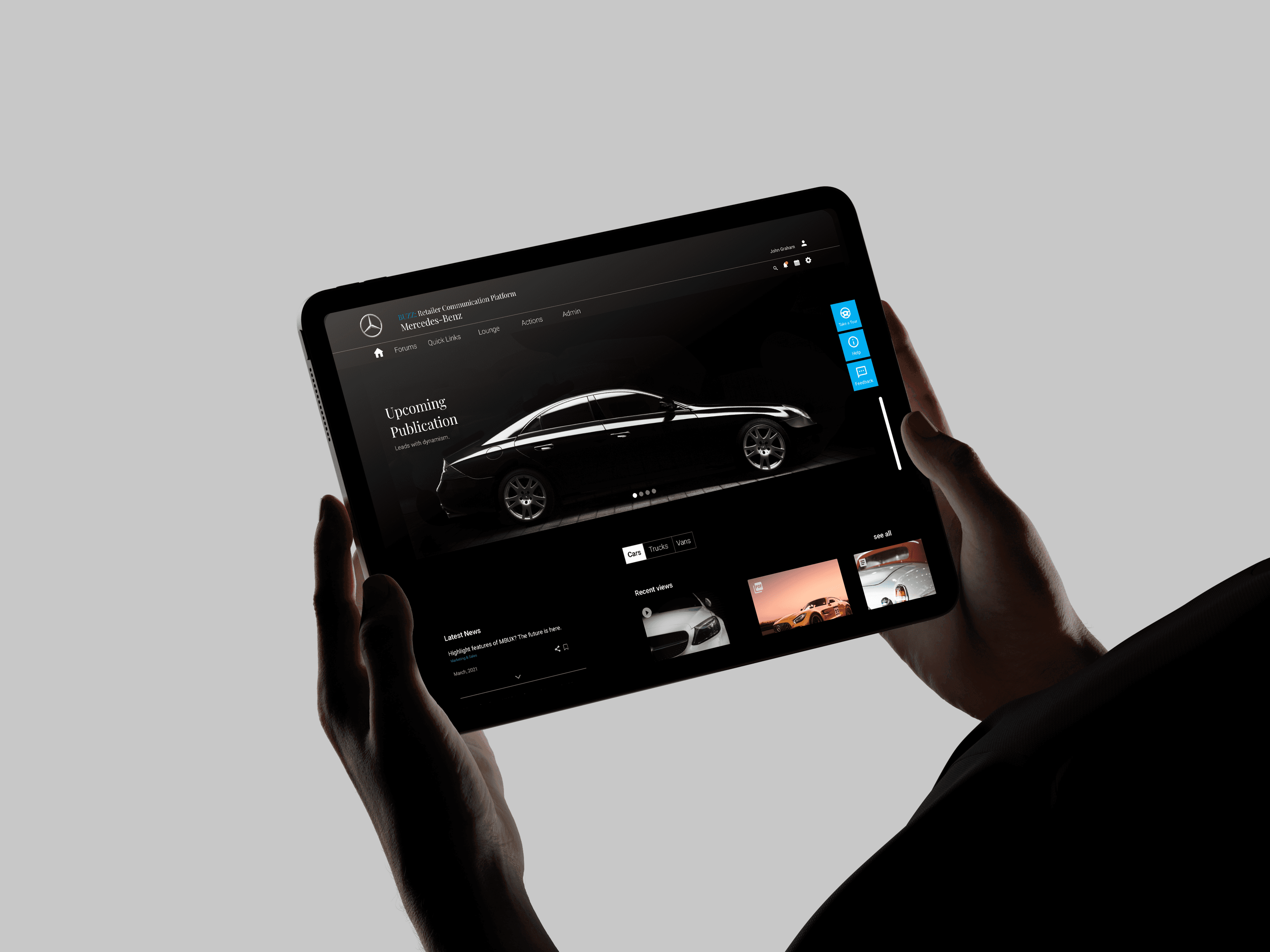
Primary navigation prioritized around retailer jobs, with entity tabs to switch between Cars, Vans, and Trucks. Quick CTAs (tour, help & support, feedback) and the latest publications surface immediately — a retailer lands and acts, no digging.

Publications
Every campaign, sales update, and parts communication from Mercedes-Benz in one browsable hub — listed, filterable, and consistent across all geographic retailers, replacing scattered emails with a single source of truth.

Product Details
Video banners bring advertising campaigns to life, with publishing dates and full context up front. A one-tap "Download All" gives retailers every related sales and marketing asset — the resources dealer staff said they lacked, now attached to the story itself.
Validation & Rollout
Unmoderated usability studies with existing MB retailers and HQ admins, then a phased rollout to 30% of UK retailers (~38k users, Apr–Jun 2023) before full release.
KPIs tracked:
TAT — platform ordering vs the traditional process
User error rates on core tasks
Conversion — task completion end to end
Engagement — how the platform settles into daily work
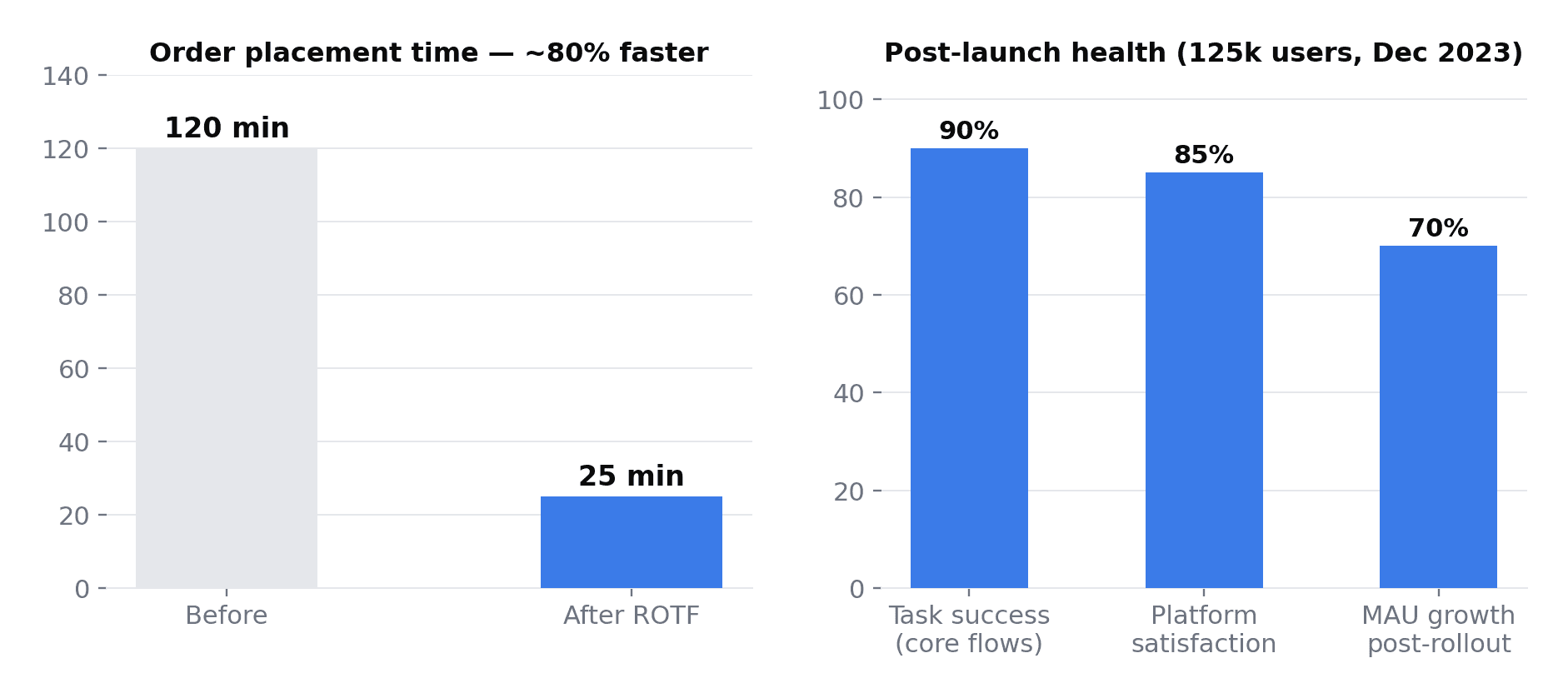
Phased rollout: 90% task success on core functions · 85% satisfaction · 40% of users landing on the homepage daily
Full release (Dec 2023): 125k users · 70% MAU increase from August · 96k monthly active
/06
Outcomes & Impact
Faster ordering (120→25 min)
~80%
Units sold via ROTF
10,000
Satisfaction (from 70%)
85%
Task success, core flows
90%
/07
Reflections
What worked:
Anchoring the design in the business-model shift, not the UI — every prioritization call got easier
Research-driven persuasion — showing stakeholders the baseline data made the revamp case for me
Close engineering collaboration from day one — 12 backend systems don't integrate themselves around a design
What I'd do differently:
Regulatory change in automotive moved under us repeatedly — I'd build compliance checkpoints into the design cadence, not react to them
Push for the invoicing feature research earlier; analytics showed zero adoption but the why took too long to chase down
Set up post-launch measurement before launch — the 2021-design-to-2023-rollout gap made attribution harder than it needed to be
/08
Email:
hello@sagarkumar.site
Phone:
+91 70668 72321
I work with brands to define who they are, design how they show up, and create experiences that matter. Less noise, more intention.
Privacy Policy
Terms of Service

ROFT Platform
Digitizing Mercedes-Benz UK's dealer network for an agency-model future — cutting a 2-hour manual ordering process to under 25 minutes and powering 10,000 vehicle sales through the platform.
Year
2020
Type
Web platform
Timeframe
Mercedes Benz (Infosys + WONGDOODY)
Problem & Context
/01
Mercedes-Benz UK was transitioning its dealer network to an agency model — MB UK selling directly to customers with franchise partners as agents, holding zero inventory.
The existing sales process couldn't support this: placing a single vehicle order took ~2 hours of manual paperwork, verification, and submission, with a 23% error and rejection rate.
Meanwhile, HQ-to-retailer communication was fragmented — dealers learned about campaigns and stock late, and more than 50% of customers believed dealerships weren't fully informed about products and offers.
Research & Discovery
/02
Research ran in two passes: secondary research with business and data analytics teams to establish the baseline, then primary qualitative research with every user type on the platform.
Methods:
App analytics — event data showed merchants used only the traditional sales flow; invoicing and payment features had near-zero adoption
12+ interviews — focus groups and one-on-ones across Head Office users, admins, retailers, staff, and support teams
Competitive benchmarking — Toyota Central Media Hub, Nissan Dealer Portal (NNA 2.0), Fuso Dealer Web Portal
Stakeholder interviews with MB UK network-effectiveness managers
Who the Platform Serves
/03
Two personas anchored every prioritization call — the retailer consuming information and placing orders, and the HQ admin publishing and resolving.
Amelia — Retailer (UK)
Runs sales and operations; needs campaigns, publications, sales reports, and parts availability in one place, mobile-friendly, with notifications tuned to her preferences. Today she can't track sales or stock progress in real time and hears about publications late.
John — Manager, Network Effectiveness (MBUK HQ)
Publishes campaigns and updates to the entire network; needs publication rights, request tracking, flagging, MFA/SSO, and an audit trail of who accessed confidential documents like rates. Today there's no single platform to manage, track, and resolve retailer concerns.
From user statements to opportunities:
"It takes around 2 hours to place a single order manually" → target an 80% reduction via digital ordering
"We often make mistakes entering details" → automated validation and error-checking at input
"Hard to keep track of inventory levels" → real-time stock visibility inside the order flow
"Orders delayed or lost due to miscommunication" → transparent status with notifications both ways
"During peak seasons it's impossible to keep up" → design for volume from day one
The Business Shift the Design Had to Serve
/04
This wasn't a UI refresh — it was a platform for a new business model. Under Retail of the Future, MB UK becomes the seller of record: it sets prices, owns inventory, and invoices customers directly. Franchise partners become agents — zero inventory, no market risk, competing purely on customer experience. Every platform capability maps to making that model operable.
What this meant for the design:
Ordering had to be real-time against MB UK's central inventory — the dealer no longer buffers with local stock
Pricing transparency became a feature: best-price guarantee means no negotiation UI, only configuration
Publications and campaigns became operationally critical — agents sell with HQ's information or not at all
Role- and entity-based access: confidential rates visible to the right roles, with download/share limits and audit trails
Homepage
Primary navigation prioritized around retailer jobs, with entity tabs to switch between Cars, Vans, and Trucks. Quick CTAs (tour, help & support, feedback) and the latest publications surface immediately — a retailer lands and acts, no digging.
Publications
Every campaign, sales update, and parts communication from Mercedes-Benz in one browsable hub — listed, filterable, and consistent across all geographic retailers, replacing scattered emails with a single source of truth.
Product Details
Video banners bring advertising campaigns to life, with publishing dates and full context up front. A one-tap "Download All" gives retailers every related sales and marketing asset — the resources dealer staff said they lacked, now attached to the story itself.
Validation & Rollout
/06
Unmoderated usability studies with existing MB retailers and HQ admins, then a phased rollout to 30% of UK retailers (~38k users, Apr–Jun 2023) before full release.
KPIs tracked:
TAT — platform ordering vs the traditional process
User error rates on core tasks
Conversion — task completion end to end
Engagement — how the platform settles into daily work
Phased rollout: 90% task success on core functions · 85% satisfaction · 40% of users landing on the homepage daily
Full release (Dec 2023): 125k users · 70% MAU increase from August · 96k monthly active
Reframing & Prioritization
/05
The redefined problem: replace a process-oriented sales journey full of manual information retrieval with one that enables selling — everything at the consultant's fingertips so they never leave the customer's side. Technically: integrate up to 12 backend systems from multiple vendors into a single platform that works across markets.
Goals set:
Best-in-class help & support — self-serve help with query tracking
Cross-market usage — functions that translate across regions
Functional minimalism — every feature the client needs, nothing decorative
A measurably better experience — TAT, error rate, and satisfaction as the scorecard
MoSCoW analysis clustered the backlog: real-time ordering, publications, and role-based access were Musts; community forum and advanced analytics moved to Later. Even the product's name was a designed decision — Buzz won over Pulse and Engage in the naming exploration for the communication platform.
Reflections
/08
What I'd do differently:
Regulatory change in automotive moved under us repeatedly — I'd build compliance checkpoints into the design cadence, not react to them
Push for the invoicing feature research earlier; analytics showed zero adoption but the why took too long to chase down
Set up post-launch measurement before launch — the 2021-design-to-2023-rollout gap made attribution harder than it needed to be
What worked:
Anchoring the design in the business-model shift, not the UI — every prioritization call got easier
Research-driven persuasion — showing stakeholders the baseline data made the revamp case for me
Close engineering collaboration from day one — 12 backend systems don't integrate themselves around a design
Email:
hello@sagarkumar.site
Phone:
+91 70668 72321


I work with brands to define who they are, design how they show up, and create experiences that matter. Less noise, more intention.
Privacy Policy
Terms of Service
Outcomes & Impact
/07
Faster ordering (120→25 min)
~80%
Units sold via ROTF
10,000
Satisfaction (from 70%)
85%
Task success, core flows
90%