Partners Platform
Transforming PayU's partner ecosystem from a KAM-dependent onboarding process into a scalable self-service platform—reducing onboarding drop-off by 40%, accelerating merchant activation, and improving operational efficiency.
Year
2022
Type
B2B web App
Timeframe
8-10 Weeks
My Role
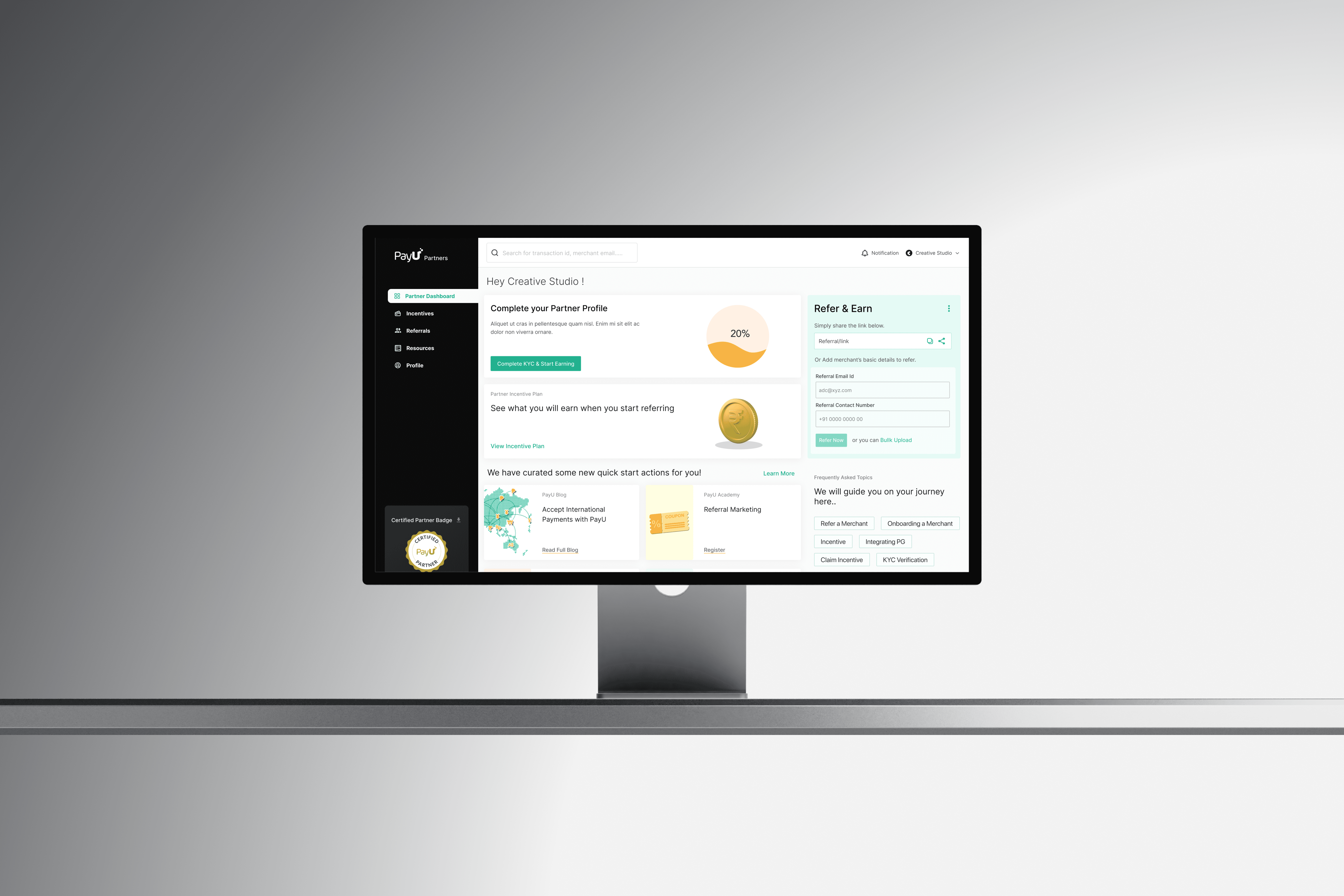
As the Lead Product Designer, I led the end-to-end redesign of PayU's Partner Platform with the objective of transforming a support-heavy onboarding process into a scalable self-service experience.
Beyond designing the interface, I worked closely with Product Managers, Engineering, Business teams, and Key Account Managers to understand operational challenges, identify opportunities for automation, and create an experience that balanced business goals with partner needs.
Responsibilities:
• Led discovery workshops and user research
• Mapped the complete partner onboarding journey
• Defined product information architecture
• Designed end-to-end onboarding, merchant management, and incentive workflows
• Facilitated cross-functional design reviews
• Supported engineering during implementation
/01
Problem & Context
PayU's partner programme — developers, resellers, and enterprise platforms who refer merchants and earn incentives — was a strong growth channel on paper: 300 active partners, 350,000 referred merchants,
40 billion in transaction volume. In reality, the platform was failing everyone involved.
The business problem:
40% of partners dropped off during merchant onboarding — direct revenue loss
Every step that should have been self-serve required a KAM (Key Account Manager) call
Business was absorbing the cost in support time and lost conversions
60+ pain points across 7 journey stages, documented but unaddressed
No transparent timelines — KYC verification showed "TBD" instead of actual days
Incentive calculations were a black box — partners couldn't verify their own earnings
/01

Research & Discovery
The brief said "redesign the platform." I resisted the brief — a redesign brief almost always hides a more specific problem. Before opening Figma, I needed to know what redesign actually meant here.
Methods:
14 in-depth user interviews across 5 partner groups — deliberately including partners who quit
Groups: active resellers, new resellers, stuck resellers (abandoned midway), enterprise platform partners, internal sales stakeholders
Gap analysis — mapping user needs at each journey stage vs what the platform offered
Support ticket + KAM call log analysis — what were partners actually calling about
Journey mapping across all 7 stages from signup to incentive payout
View Atrifacts
/02


In Their Own Words
10 end users and 4 internal stakeholders interviewed across developer, reseller and enterprise personas. These moments defined what the redesign had to solve.


/03
Key Insights
The stuck resellers gave the most useful data:
Recruiting people who quit — not just people succeeding — revealed the real failure points. Their abandonment reasons were structural, not cosmetic.
It was never about the UI:
No transparent timelines, black-box incentives, forced KAM dependency at every step. The platform structurally didn't support self-serve at any stage.
The navigation reflected PayU's org chart, not partner jobs:
11 nav items ordered by PayU's internal product structure. A reseller thinks: add a merchant, check if they're live, see what I've earned. The IA fought them at every step.
KAM calls were a symptom, not a preference:
Partners didn't want to call KAMs. They called because the dashboard gave them no other path. Every call was a self-serve failure logged as a support interaction.
/04
Design Constraints
The challenge extended far beyond improving usability.
The platform had to support multiple partner types, reduce operational dependency, and integrate with existing business processes without disrupting ongoing merchant onboarding.
We designed within five key constraints::
• Multiple partner personas with different workflows
• Complex merchant verification and compliance requirements
• Legacy information architecture centred around internal teams
• High dependency on Key Account Managers
• Incremental rollout without affecting existing business operations
/05

Design Approach &
Principles
The strategic shift: restructure the platform around partner jobs-to-be-done, not PayU's product taxonomy — and make every journey stage self-serve by default, with KAM escalation as the exception.
Principles:
Task-based IA — navigation follows what partners do, not what PayU sells
Radical transparency — every process shows real timelines, every incentive shows its math
Self-serve first — KAM contact is an escalation path, never a requirement
Progressive onboarding — partners see value before completing full KYC
Status visibility — partners always know where every merchant is in the pipeline
/06
Ideation & Exploration
Before wireframing a single screen, I restructured the information architecture. Five primary sections
replaced eleven — organized around the partner's job-to-be-done.

/07
Design Decisions
Restructured IA from 11 product-based items to 5 task-based sections
What: Navigation reorganized around partner jobs: Add Merchants, Track Status, Earnings, Resources, Account.
Why: Research showed partners think in tasks, not PayU's product categories. This single structural change reduced time-to-first-action across every flow measured.

/08
Decision 01 - Organising Around Partner Goals
Rather than structuring the platform around PayU's internal products, we redesigned the information architecture around the partner's primary tasks and decision-making process.
Trade-off
Required restructuring navigation but significantly reduced cognitive load.
Decision 02 - Self-Service as the Default
Instead of encouraging partners to contact KAMs for routine activities, we redesigned the platform so onboarding, merchant management, and incentive tracking could be completed independently.
Trade-off
Higher product complexity but substantially lower operational dependency.
Decision 03 - Transparent Merchant Progress
Partners frequently contacted KAMs simply to understand merchant status.
Rather than hiding process details, we exposed onboarding stages, verification progress, and next actions directly within the dashboard.
Trade-off
More information on screen but dramatically improved transparency.
Decision 04 - Reusable Patterns
Instead of solving each workflow individually, we created reusable interaction patterns that could scale across future PayU partner products.
Final Designs
The complete Partner Journey
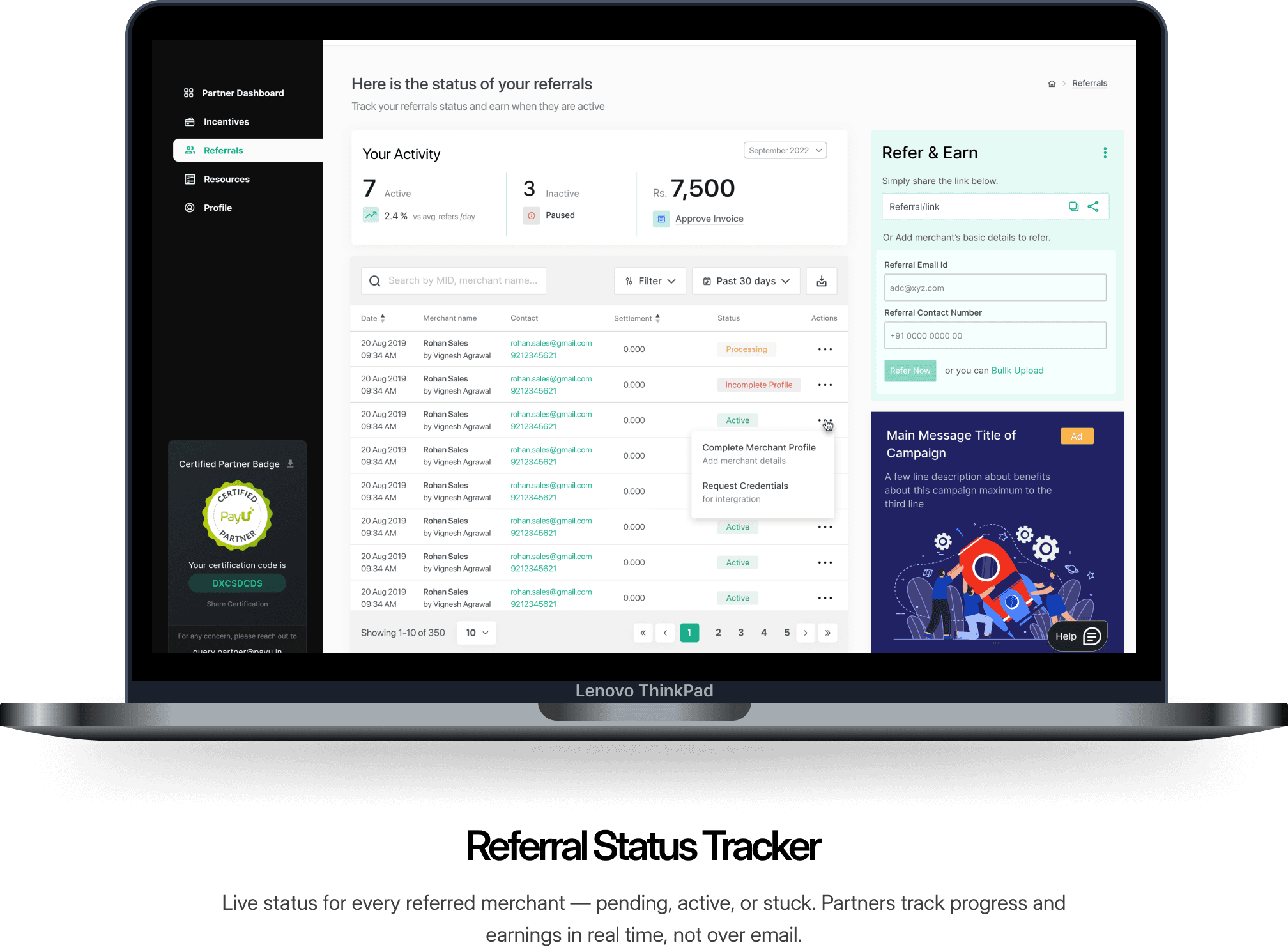
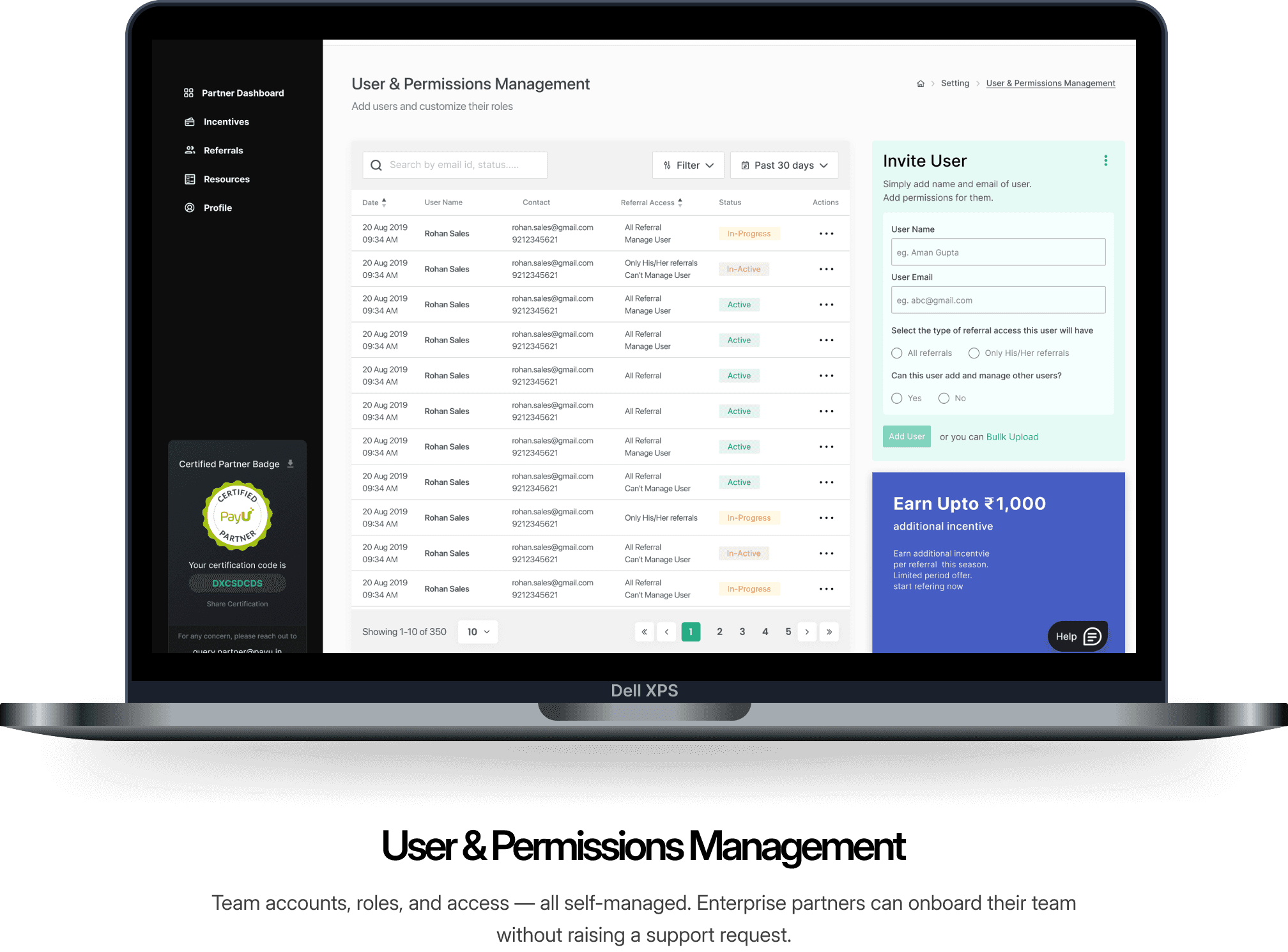
From discovery to first incentive — 4 key stages, each redesigned to remove human dependency from the critical path.
Beyond Design
While the redesign improved the user experience, one of the most valuable outcomes was aligning multiple teams around a shared vision of self-service.
Working closely with Product Managers, Engineering, Business stakeholders, and Key Account Managers helped ensure that design decisions reflected operational realities rather than ideal scenarios.
The resulting information architecture, onboarding principles, and reusable interaction patterns became a strong foundation for future B2B initiatives.
/09




Outcomes & Impact
Drop-off reduction
40%
Faster onboarding
3x
KAM call volume
-55%
CSAT Improvement
+61%
Onboarding drop-off reduced by 40% — directly recovering lost activations
Onboarding completion 3x faster with self-serve flows and inline validation
KAM call volume significantly reduced — calls shifted from routine status checks to genuine escalations
Task-based IA adopted as the pattern for other PayU B2B products
Incentive transparency eliminated the #2 support call category entirely
/10
Reflections
What worked:
Resisting the "redesign" brief and finding the structural problem first — the IA restructure did more than any visual change
Recruiting stuck/churned partners for research — their data was the most actionable
Fixing trust (timelines, incentive math) before fixing aesthetics
What I'd do differently:
Involve KAMs earlier — they initially saw self-serve as a threat to their role; earlier alignment would have smoothed rollout
Instrument the funnel before redesign started — baseline data took weeks to reconstruct
Phase the IA change more gradually — existing partners needed more migration support than anticipated
/11
In Their Own Words
10 end users and 4 internal stakeholders interviewed across developer, reseller and enterprise personas. These moments defined what the redesign had to solve.
/03
Key Insights
/04
The stuck resellers gave the most useful data:
Recruiting people who quit — not just people succeeding — revealed the real failure points. Their abandonment reasons were structural, not cosmetic.
It was never about the UI:
No transparent timelines, black-box incentives, forced KAM dependency at every step. The platform structurally didn't support self-serve at any stage.
The navigation reflected PayU's org chart, not partner jobs:
11 nav items ordered by PayU's internal product structure. A reseller thinks: add a merchant, check if they're live, see what I've earned. The IA fought them at every step.
KAM calls were a symptom, not a preference:
Partners didn't want to call KAMs. They called because the dashboard gave them no other path. Every call was a self-serve failure logged as a support interaction.
Email:
hello@sagarkumar.site
Phone:
+91 70668 72321
I work with brands to define who they are, design how they show up, and create experiences that matter. Less noise, more intention.
Privacy Policy
Terms of Service

Design Approach & Principles
/05
The strategic shift: restructure the platform around partner jobs-to-be-done, not PayU's product taxonomy — and make every journey stage self-serve by default, with KAM escalation as the exception.
Principles:
Task-based IA — navigation follows what partners do, not what PayU sells
Radical transparency — every process shows real timelines, every incentive shows its math
Self-serve first — KAM contact is an escalation path, never a requirement
Progressive onboarding — partners see value before completing full KYC
Status visibility — partners always know where every merchant is in the pipeline
Ideation & Exploration
/06
Before wireframing a single screen, I restructured the information architecture. Five primary sectionsreplaced eleven — organized around the partner's job-to-be-done.
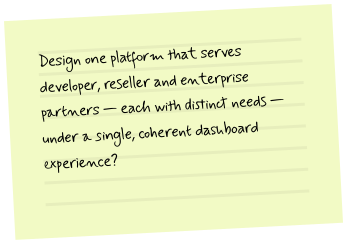


Make the full partner journey self-serve
From discovery to first incentive, every step completable on the dashboard — no KAM email, no offline form, no waiting.
Design for all 3 partner types
One platform, three journeys. Developer, reseller and enterprise partners each have distinct needs — the dashboard must serve all without compromise.
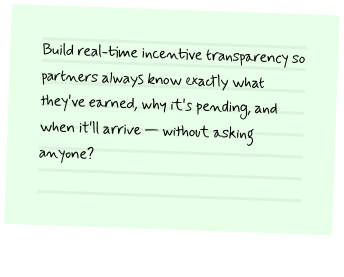
Build real-time incentive transparency
Daily breakdowns, pending amounts and claim status visible on the dashboard — eliminating the trust gap that was driving partners to competitors.
Design Decisions
/07
Restructured IA from 11 product-based items to 5 task-based sections
What: Navigation reorganized around partner jobs: Add Merchants, Track Status, Earnings, Resources, Account.
Why: Research showed partners think in tasks, not PayU's product categories. This single structural change reduced time-to-first-action across every flow measured.


Final Designs
/07
The complete Partner Journey
From discovery to first incentive — 4 key stages, each redesigned to remove human dependency from the critical path.
PARTNERS PLATFORM
Redesigning a B2B partner platform end-to-end — from a KAM-dependent dashboard to a self-serve experience that cut onboarding drop-off by 40%.
Year
2022
Type
B2B web App
Timeframe
8-10 Weeks
Problem & Context
/01
PayU's partner programme — developers, resellers, and enterprise platforms who refer merchants and earn incentives — was a strong growth channel on paper: 300 active partners, 350,000 referred merchants,
40 billion in transaction volume. In reality, the platform was failing everyone involved.
The business problem:
40% of partners dropped off during merchant onboarding — direct revenue loss
Every step that should have been self-serve required a KAM (Key Account Manager) call
Business was absorbing the cost in support time and lost conversions
60+ pain points across 7 journey stages, documented but unaddressed
No transparent timelines — KYC verification showed "TBD" instead of actual days
Incentive calculations were a black box — partners couldn't verify their own earnings
Research & Discovery
Methods:
14 in-depth user interviews across 5 partner groups — deliberately including partners who quit
Groups: active resellers, new resellers, stuck resellers (abandoned midway), enterprise platform partners, internal sales stakeholders
Gap analysis — mapping user needs at each journey stage vs what the platform offered
Support ticket + KAM call log analysis — what were partners actually calling about
Journey mapping across all 7 stages from signup to incentive payout
/02
Outcomes & Impact
/08
Drop-off reduction
40%
Faster onboarding
3x
KAM call volume
-55%
CSAT Improvement
+61%
Onboarding drop-off reduced by 40% — directly recovering lost activations
Onboarding completion 3x faster with self-serve flows and inline validation
KAM call volume significantly reduced — calls shifted from routine status checks to genuine escalations
Task-based IA adopted as the pattern for other PayU B2B products
Incentive transparency eliminated the #2 support call category entirely
Reflections
/09
What I'd do differently:
Involve KAMs earlier — they initially saw self-serve as a threat to their role; earlier alignment would have smoothed rollout
Instrument the funnel before redesign started — baseline data took weeks to reconstruct
Phase the IA change more gradually — existing partners needed more migration support than anticipated
What worked:
Resisting the "redesign" brief and finding the structural problem first — the IA restructure did more than any visual change
Recruiting stuck/churned partners for research — their data was the most actionable
Fixing trust (timelines, incentive math) before fixing aesthetics
Email:
hello@sagarkumar.site
Phone:
+91 70668 72321


I work with brands to define who they are, design how they show up, and create experiences that matter. Less noise, more intention.
Privacy Policy
Terms of Service